01CAD frozen · fabrication in progress
Undercarriage
Tracked drivetrain sized for greenhouse rows and wet soil: track carriers, idlers, drive sprockets, split road rollers, hubs and axles on a welded frame.
Read moreExplore the V3
Turn the robot, zoom in, and select a component to see how it works.
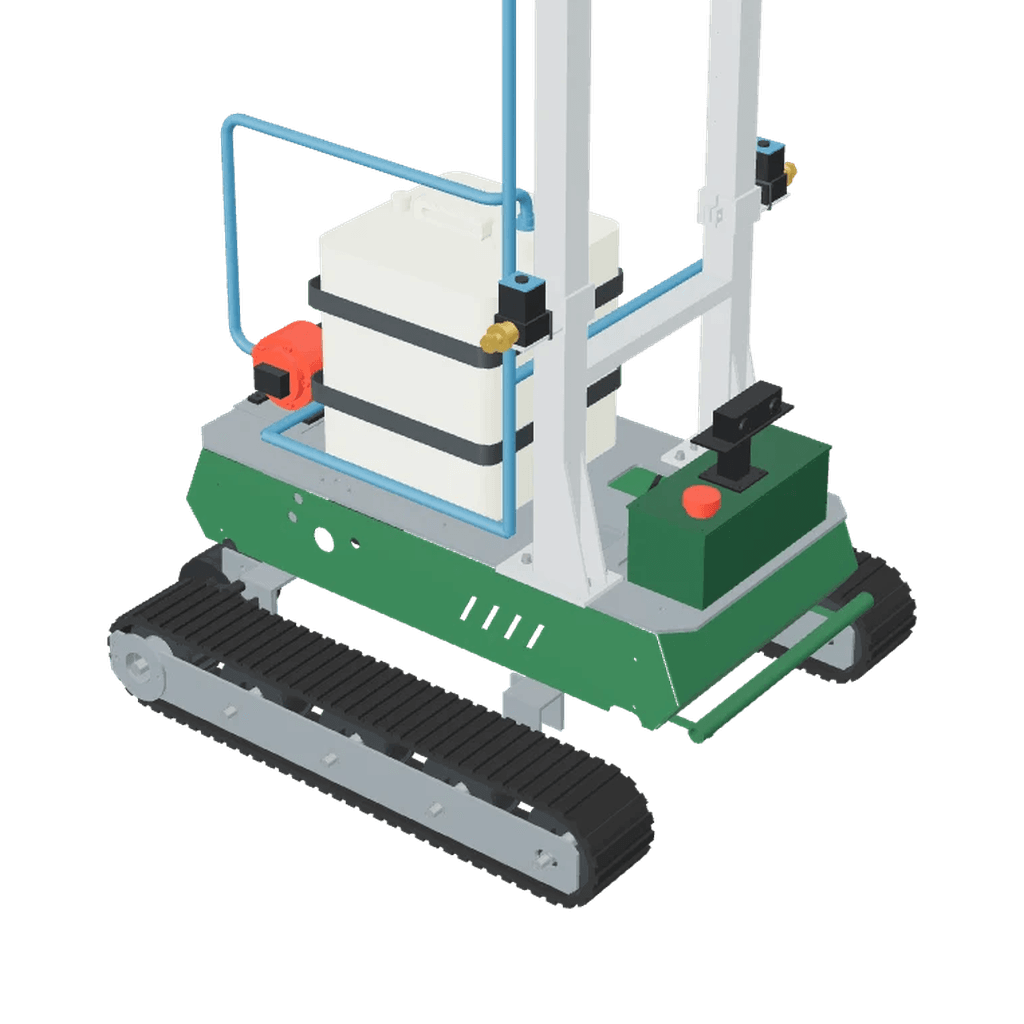
Drag to rotate · Scroll or pinch to zoom · Click a part
Select a part on the robot or from the list.
V3 CAD design, revision A08 · Assembly and field testing in progress
Engineering log
We're building CropScout as three subsystems that bolt onto one base: a tracked undercarriage, an ML/AI crop-vision stack, and a precision sprayer. This page is the evidence: the working MVP, the boards we designed, the CAD, and the plan behind it.
3
Subsystems, one base
$3,000
Funding received so far
7
Custom PCBs in the MVP
30
Farmers interviewed
Subsystems
Each subsystem is owned by a founder, with its own hardware and its own test. They meet at one mechanical interface, one 24V bus, and one CAN network.
Tracked drivetrain sized for greenhouse rows and wet soil: track carriers, idlers, drive sprockets, split road rollers, hubs and axles on a welded frame.
Read moreCrop and leaf detection plus disease screening, running as ONNX models in the browser today and on the robot's own compute next.
Read morePrecision spraying on the same base: a 5 US-gallon tank, a 24V pump, and solenoid valves that dose per plant.
Read moreThe MVP
A real, driving, sensing rover: a steerable four-wheel base, a controllable front arm, soil and air sensing, and a wireless controller talking to it over MQTT. Built and presented at the ASU Fulton Innovation Showcase in front of 500+ people.
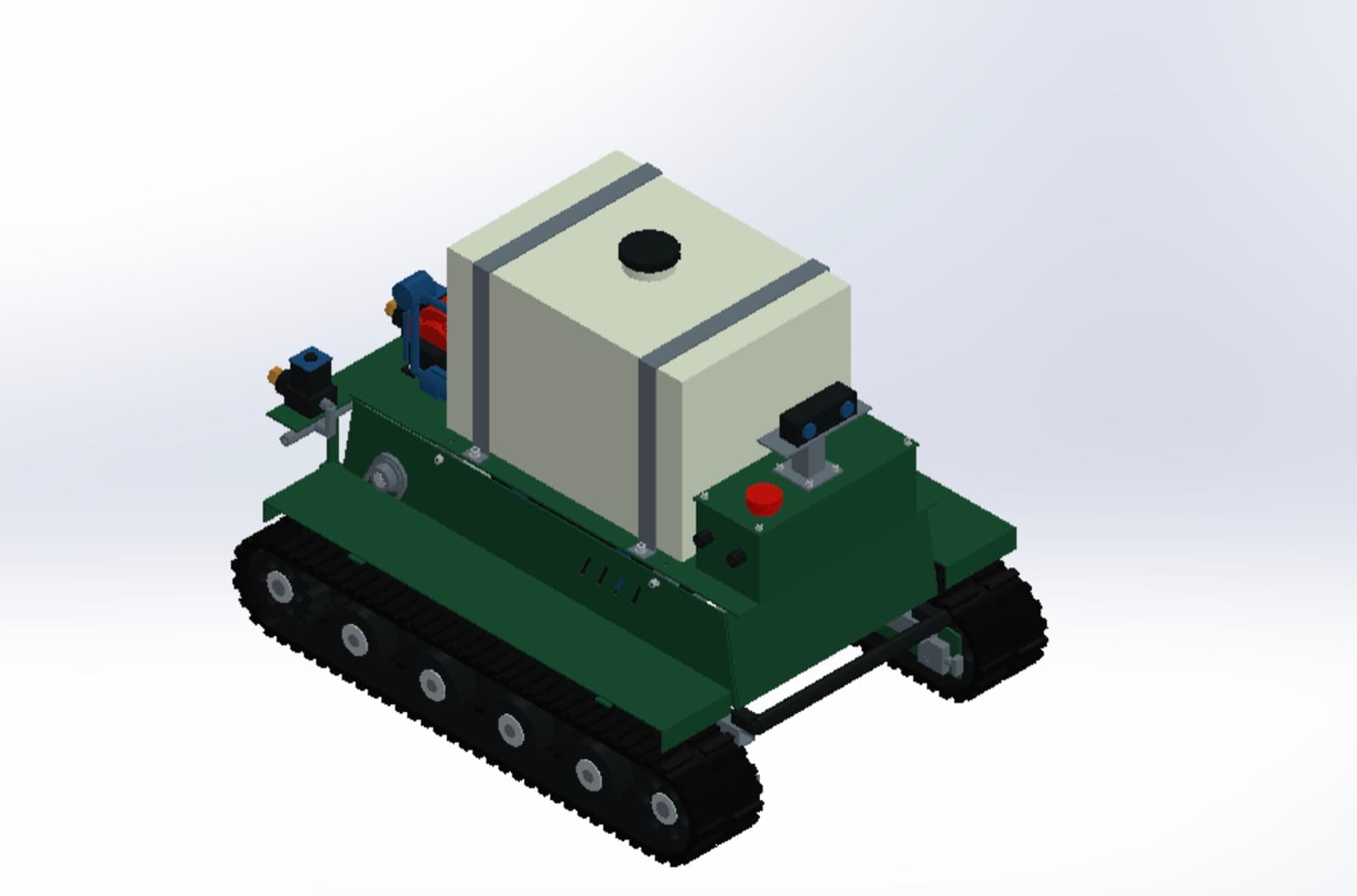
The MVP was a four-wheel rover the size of a suitcase. Farmers told us to make it bigger and let it carry more than one tool, so the V2 base is a tracked undercarriage designed from scratch in SolidWorks.
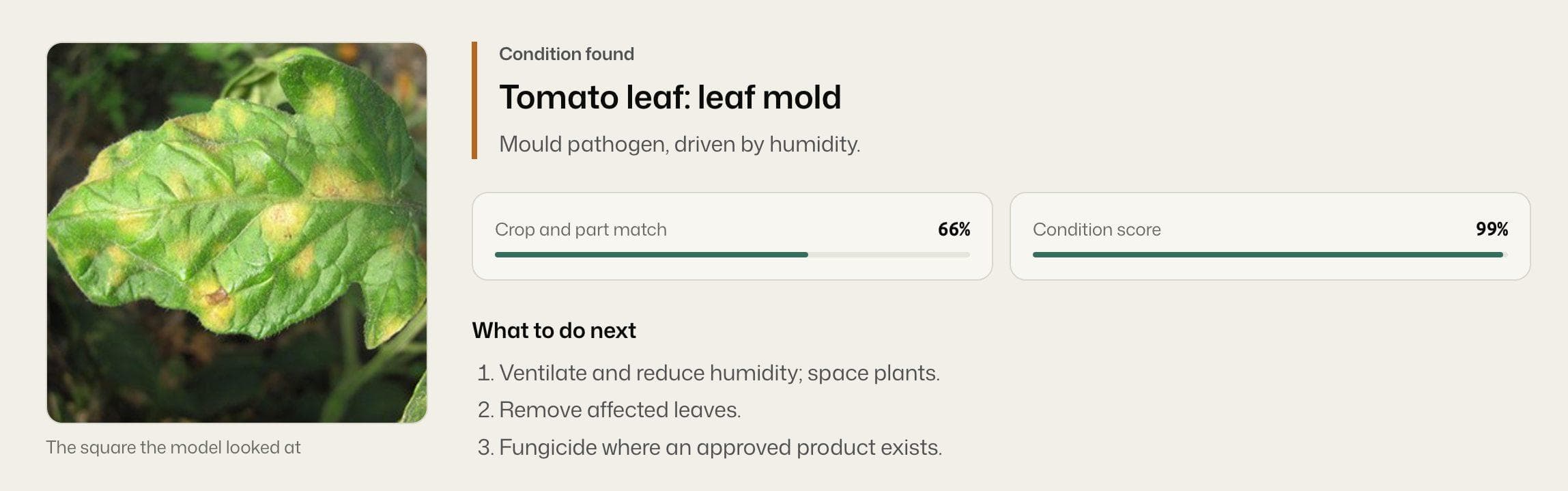
CropScout Vision runs two stages: first, is this a supported crop, and a leaf or a fruit; then the closest covered condition for that crop and part, with a confidence score and the alternatives it considered. Models are exported to ONNX and run in the browser with ONNX Runtime Web, so photos never leave the phone. We judge every model change against our own field photographs, not a lab validation split — that is where studio-heavy public datasets fall over.
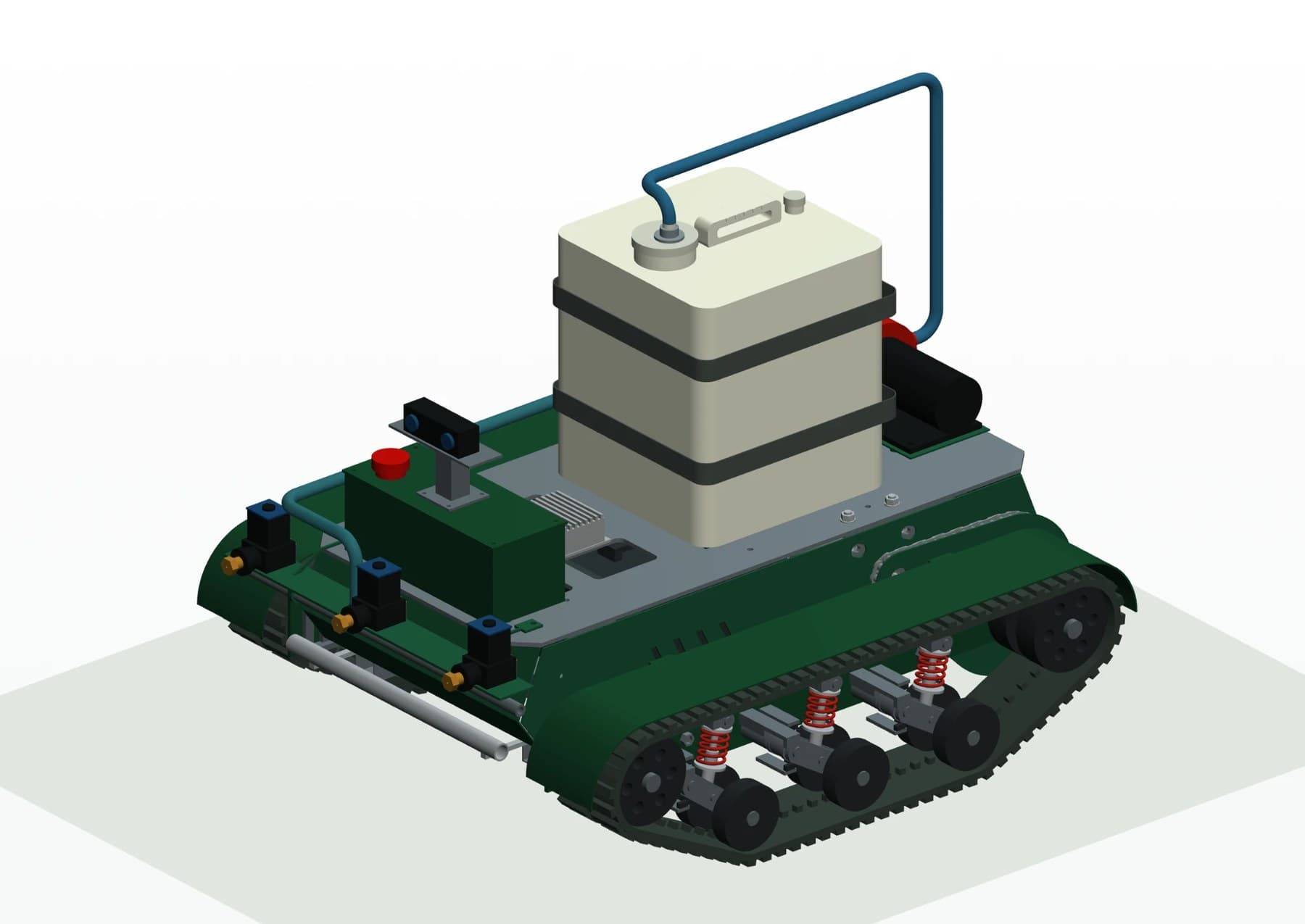
Spraying was the second-largest time cost and the single largest cash cost our farmers named. The sprayer module is what CropScout does first with the base and the vision stack.
Electronics
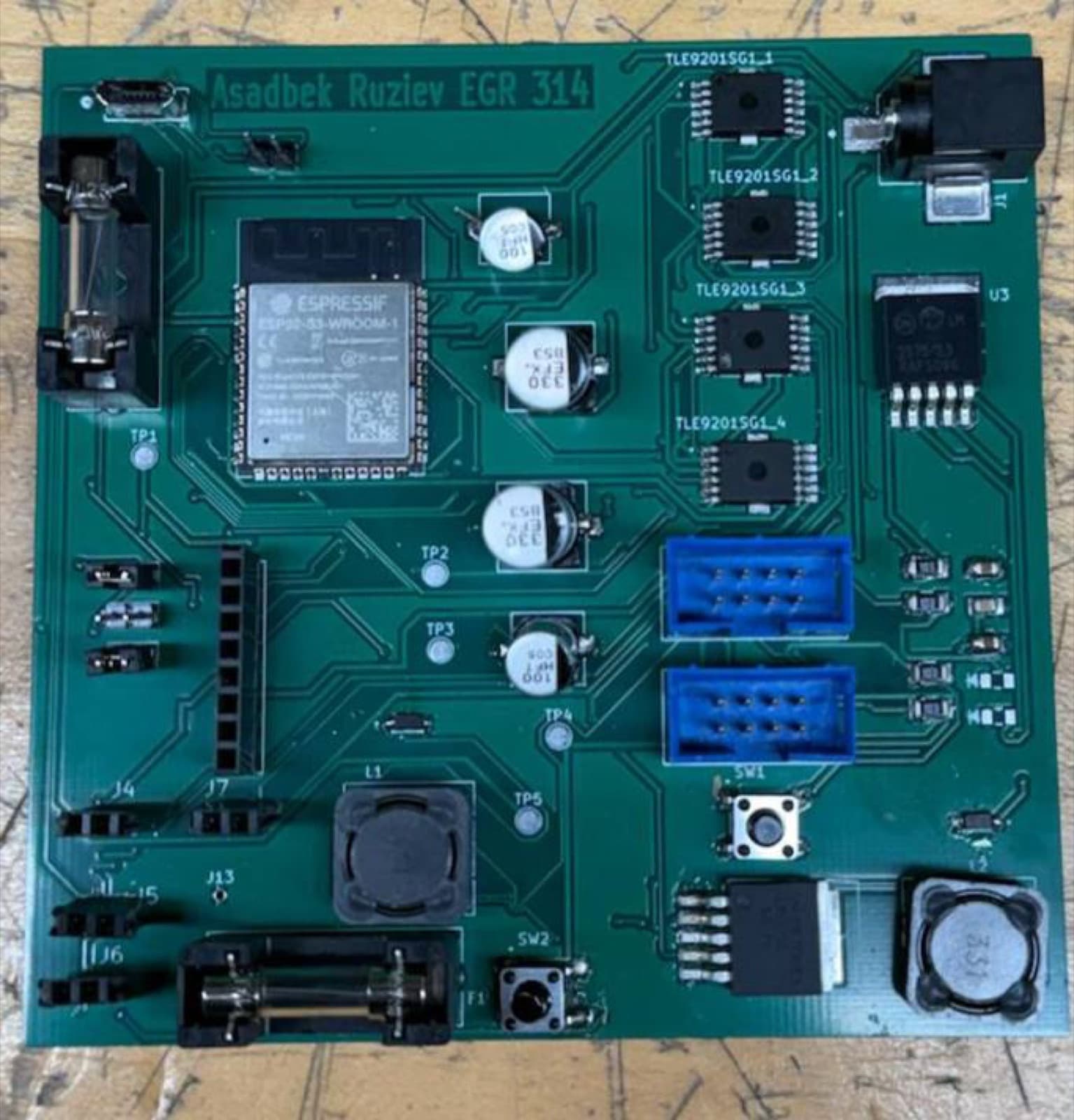
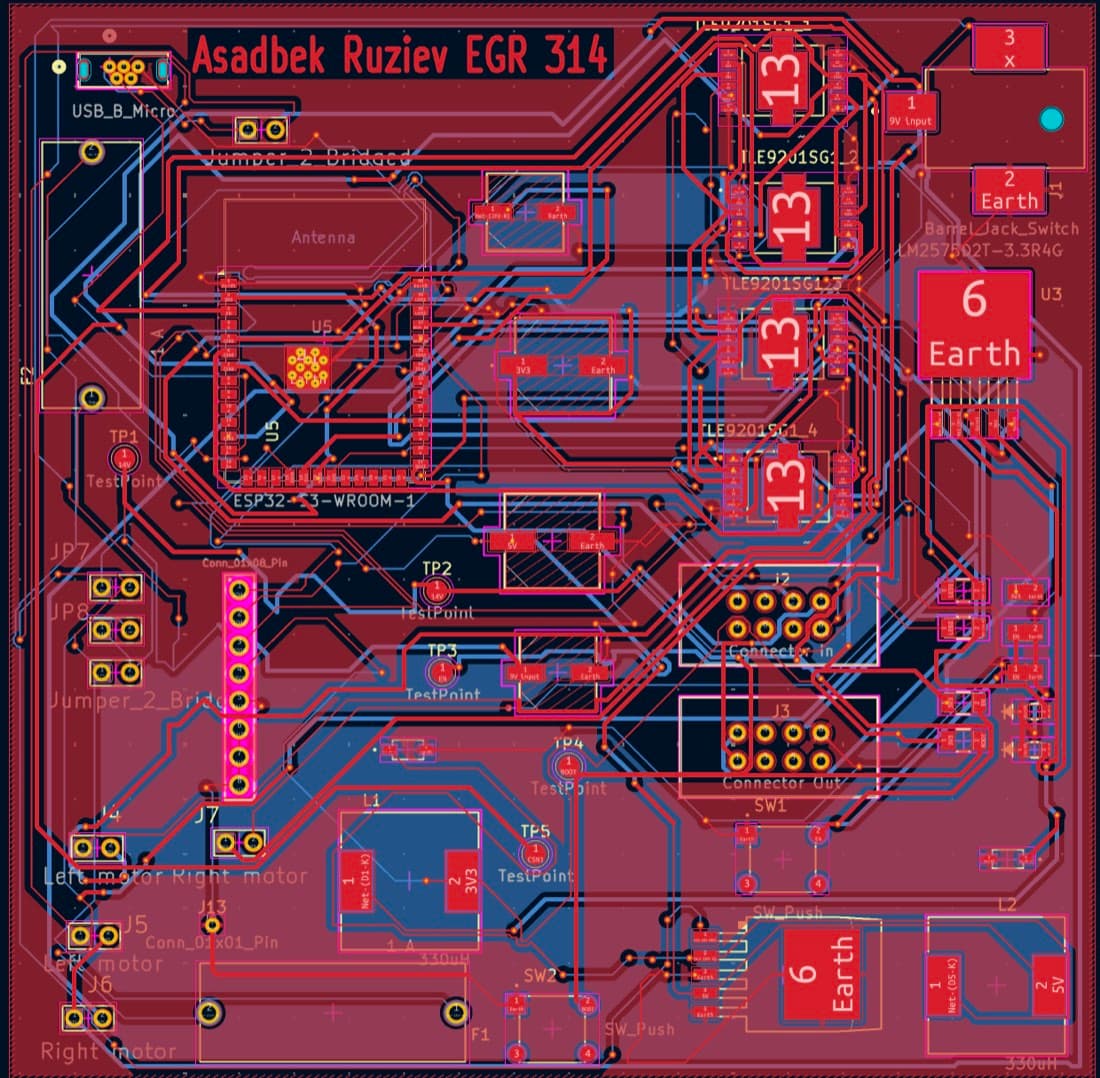
Every PCB in the MVP was designed and assembled by us: schematic, layout, fabrication, bring-up and debugging. The board pictured is the motor-driver node — an ESP32-S3 driving four TLE9201SG H-bridges over SPI, taking 5–40V in and regulating to 3.3V and 5.5V on board. It's one of seven PCBs in the rover's distributed architecture; firmware is MicroPython, with MQTT over TLS for commands and telemetry and a UART daisy chain to the other boards.
Next revision: the main controller moves to a Teensy 4.1, for more headroom, CAN bus and real-time control, and a Jetson-class module joins the stack so Vision runs onboard.
Open build days
Two open build days at ASU Polytechnic's SIM Building, for anyone who wants to see the robot come together.
Friday, 9 October 2026
Thursday, 30 October 2026
Funding & links
Funding received so far
Every dollar so far has gone into hardware: track parts, the 24V pack, pump and tank, PCB fabrication and the components on them. CropScout is backed by UzCombinator, Batch 2, 2026, and built by BESTARORG at ASU Polytechnic with a team of student engineers.
Want to fund a subsystem, or put a robot on your plots for the pilot?
info@bestarorg.uz